



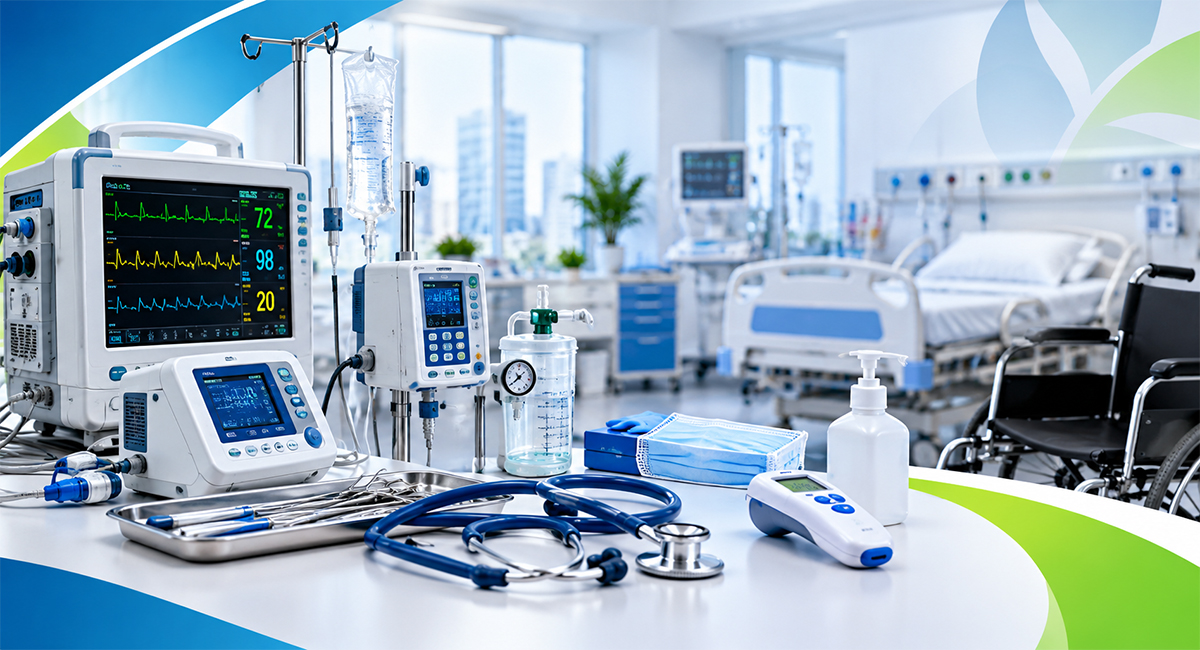
The choice of medical equipment is an important issue for any medical institution, be it a hospital, clinic, diagnostic centre or any other healthcare facility. Proper use of equipment can aid in the successful execution of workflow, accurate monitoring, patient care and future planning.
Purchasing medical equipment, however, isn’t just about the lowest price or the greatest features.
Before purchasing, hospitals and clinics must take clinical needs, equipment specifications, safety, quality, training of staff, installation, maintenance, guarantees and warranties and consumables and after-sales service into account.
Similarly, WHO suggests that technical specifications should be taken into account when buying medical devices and that the implementation, operation and maintenance of the devices should be planned.
This medical equipment buying guide will detail the important considerations for hospitals and clinics to consider before buying medical equipment.
What Should You Consider Before Buying Medical Equipment?

When contacting a supplier, be sure to know:
- What is the equipment required for?
- Which department will use it?
- How frequently will it be used?
- Who will operate it?
- What specifications are required?
- What is the available budget?
- What installation requirements are needed?
- How much will maintenance cost?
- Is training required?
- What warranty and after sales support are available?
It can be easier to evaluate and more practical to consider procurement based on the healthcare requirement rather than a product catalogue.
1. Identify Your Hospital or Clinic’s Exact Requirement
The first step in buying medical equipment is to determine the clinical and operational need.
For instance, a general physician’s clinic might need the following equipment:
- Blood pressure monitor
- Pulse oximeter
- ECG machine
- Nebulizer
- Examination equipment
- Patient weighing scale
A hospital’s needs could be quite wide ranging and may encompass:
- Patient monitors
- ECG machines
- Defibrillators
- Ventilators
- Infusion pumps
- Syringe pumps
- Hospital beds
- Suction machines
- Oxygen equipment
- ICU equipment
- Diagnostic equipment
Don’t ask which medical equipment is best, rather ask:
What equipment is necessary for the services that our facility provides?
This can help prevent buying equipment that isn’t suitable for your clinical demands or facility needs.
2. Choose Equipment Based on the Department
Each department has an equipment requirement that’s unique to them.
ICUs may need equipment like:
- Multiparameter patient monitors
- ICU ventilators
- Infusion pumps
- Syringe pumps
- Defibrillators
- Suction machines
- ICU beds
- Oxygen-related equipment
- General Clinic
General Clinic
- BP monitors
- Pulse oximeters
- ECG machines
- Nebulizers
- Examination equipment
Diagnostic Centre
Depending on the services to be provided, the diagnostic facilities required may be:
- ECG machines
- Holter monitors
- ABPM devices
- PFT/spirometry equipment
- Patient monitoring equipment
- Equipment used in the laboratory or imaging.
Home healthcare providers will need:
- Oxygen concentrators
- CPAP machines
- BiPAP machines
- Hospital beds
- Suction machines
- Wheelchairs
- Patient monitoring devices
The type of equipment must always be chosen based on clinical use and professional needs.
3. Compare Technical Specifications Carefully
Comparing the specifications of medical equipment is one of the most important aspects of medical equipment procurement.
Two products can appear identical, but have different capabilities.
When shopping, consider these aspects:
- Measurement range
- Accuracy
- Display and controls
- Battery backup
- Power requirements
- Alarm features
- Connectivity
- Accessories included
- Consumable requirements
- Operating environment
- Cleaning requirements
- The ability to integrate with other applications and software.
- Maintenance requirements
Technical specifications are particularly recommended by WHO for consideration in the procurement process, as they can assist organisations in planning for the equipment’s use, resources, maintenance, etc.
Do not compare just the number of features!
The more features, the better equipment isn’t always.
The more pertinent question is:
Do the features apply to the facility’s current needs?
4. Consider Quality and Safety
Medical equipment is used directly in the provision of health care services, with quality and safety being important parameters for buying.
Before purchasing, check:
- Manufacturer information
- Product documentation
- Applicable regulatory requirements
- Safety information
- User manuals
- Warranty terms
- Service documentation
- Replacement parts available.Parts available.
- Supplier credentials
Medical devices in India are governed by Drugs & Cosmetics Act, 1940 and Medical Devices Rules 2017, which classify medical devices in four categories – A, B, C and D based on the risk level.
When procuring in India, buyers should not simply take marketing statements like “international quality” or “CE certified” at face value and should check the regulations and licensing that may be applicable to the specific device and supplier.
5. Don’t Choose Equipment Based Only on Price
Price is important, but the cheapest to buy doesn’t necessarily mean the cheapest to buy and run.
Inefficiently, for instance, a relatively inexpensive device may later need to:
- Expensive consumables
- Frequent servicing
- Special accessories
- Software subscriptions
- Replacement parts
- Calibration
- More frequent repairs
Hence, the total cost of ownership should be taken into account since it is important to hospitals.
This may cost:
Purchase price + installation + accessories + consumables + training + maintenance + repairs + replacement parts
WHO guidance in procurement also highlights the value for money and lifecycle aspects as more important than just looking for the lowest initial cost.
6. Check Warranty and After-Sales Service
A medical device is not a “single-use” item.
It must be maintained and kept in good working order during its lifetime.
When purchasing inquire from the supplier:
- How long is the warranty ?
- What is covered by the warranty ?
- Do we have service onsite?
- How fast is the service to be provided?
- If not, are there spares available?
- Is preventive maintenance offered?
- Are calibrations available if needed?
- Do you have service contracts ?
- What if it’s past the warranty period ?
In critical care settings, a supplier that has a robust after sales support program may be of great value in dealing with equipment.
Inspection, preventive maintenance and corrective maintenance are important components of equipment maintenance, as recommended by WHO’s medical equipment maintenance guidance.
7. Check Installation Requirements
Certain medical equipment cannot be unpacked and switched on.
You may need:
- Appropriate electrical supply
- Backup power
- Space and ventilation
- Temperature or humidity control are the two main factors that can be adjusted.
- Network connectivity
- Plumbing or gas connections are the places where there are no restrictions.
- Structural support
- Special room requirements
When ordering, request a site-readiness checklist from the supplier.
This can avoid unwanted installation costs and/or delays.
8. Consider Staff Training and Ease of Use
All the world’s most sophisticated medical devices may have little value if the staff do not know how to operate them properly.
Before purchasing, find out:
- Are there training sessions for products?
- What will the training be from?
- Do you have a user’s manual?
- Are refresher training sessions available?
- Are there opportunities to provide training opportunities for new staff members later?
- Do you offer technical support following installation?
Training and maintenance planning is part of effective medical-device management, as specified by the technical specification guidance from WHO.
9. Check Consumables and Accessories
It is one of the most overlooked factors when purchasing medical equipment.
A device may require specific:
- Sensors
- Cables
- Electrodes
- Tubes
- Filters
- Masks
- Batteries
- Probes
- Printing paper
- Disposable accessories
Before buying, ask:
“What additional products do we need to operate this equipment?”
Also check:
- Availability
- Approximate recurring cost
- Compatible alternatives
- Local supply
- Replacement frequency
This will make it easier to determine the actual operating cost.
10. Evaluate the Medical Equipment Supplier
Getting the best equipment is just part of the equation.
Installation, Training, Maintenance and Long-Term Support can be greatly affected by the supplier.
You should search for a supplier that can offer you:
- Genuine products
- Clear product documentation
- Transparent quotation
- Warranty support
- Installation assistance
- Technical support
- Spare parts
- Maintenance services
- Training
- Responsive customer support
Request to see some recommendations or experience from similar hospitals, clinics or healthcare facilities as applicable.
11. Ask for a Detailed Quotation
When choosing suppliers, beware of comparing just based on the final cost.
Ask each supplier to provide an itemised quotation.
It should clearly mention:
| Requirement | What to Check |
| Product | Exact model and configuration |
| Quantity | Number of units |
| Price | Unit and total price |
| GST | Applicable taxes |
| Accessories | Included/excluded |
| Installation | Included/excluded |
| Training | Included/excluded |
| Warranty | Duration and coverage |
| Maintenance | Terms and cost |
| Consumables | Required items and pricing |
| Delivery | Expected timeline |
| Service | Support process |
This makes supplier comparison much easier.
12. Check Regulatory and Documentation Requirements
Regulatory compliance should not be an afterthought in hospitals & clinics.
Depending on the device, documentation may include applicable:
- Licence information
- Product details
- Manufacturer information
- User manual
- Warranty documents
- Test reports
- Calibration documentation
- Installation records
- Service records
CDSCO says that medical devices are regulated in India under Medical Devices Rules, 2017. The November 2025 circular also pointed out that the applicable CDSCO or State/UT licensing authorities’ licence should be mandated as a part of the procurement process for medical devices by procurement agencies such as hospitals etc.
The requirements may apply differently depending on the device and the regulatory status, buyers are advised to check the latest applicable requirement before finalising the purchase.
13. Think About Maintenance Before You Buy
One mistake is thinking of maintenance once you have bought the equipment.
Rather, inquire about maintenance when making a purchase.
A well designed medical equipment maintenance plan should contain:
- Preventive maintenance
- Performance checks
- Safety inspections
- Calibration where applicable
- Corrective repairs
- Spare parts
- Service documentation
- Equipment inventory
According to the 2025 guidance of WHO on medical-device inventory and maintenance, equipment management is an ongoing process from the needs assessment and procurement to the incoming inspection, inventory, training, maintenance and eventual decommissioning.
14. Consider New vs Refurbished Medical Equipment
A hospital or clinic can either invest in new equipment or refurbished equipment based on their facilities and budget.
New Equipment
Potential advantages:
- Latest available model
- New warranty
- Improved lifespan of service use
- Newer technology
Refurbished Equipment
Potential advantages:
- Lower initial investment
- Access to existing models, if available.
But, refurbished gear needs to be assessed thoroughly.
Ask about:
- Refurbishment process
- Previous usage
- Testing
- Warranty
- Service history
- Replacement parts
- The estimated useful life of the item.
Technical evaluation should be done by suitably qualified people before purchasing critical equipment.
15. Should Hospitals Buy or Rent Medical Equipment?
Not every time it’s just a matter of buying.
Rental may be taken into account:
- Equipment is required for a short time.
- The volume of patients is not known.
- The facility would like to refrain from purchasing a significant amount of equipment initially.
- A device must be used for a short term project
- The hospital wants to assess equipment prior to purchasing it for long term use.
Buying might be more suitable when:
- Regularly requires equipment.
- It is hoped that it will be used for the long haul
- The facility desires that it be available permanently.
- Ownership is financially viable during the expected life of the product.
A decision should be made on the basis of usage, duration, total cost and operational requirements based on usage, not price.
Medical Equipment Buying checklist for Hospitals & Clinics
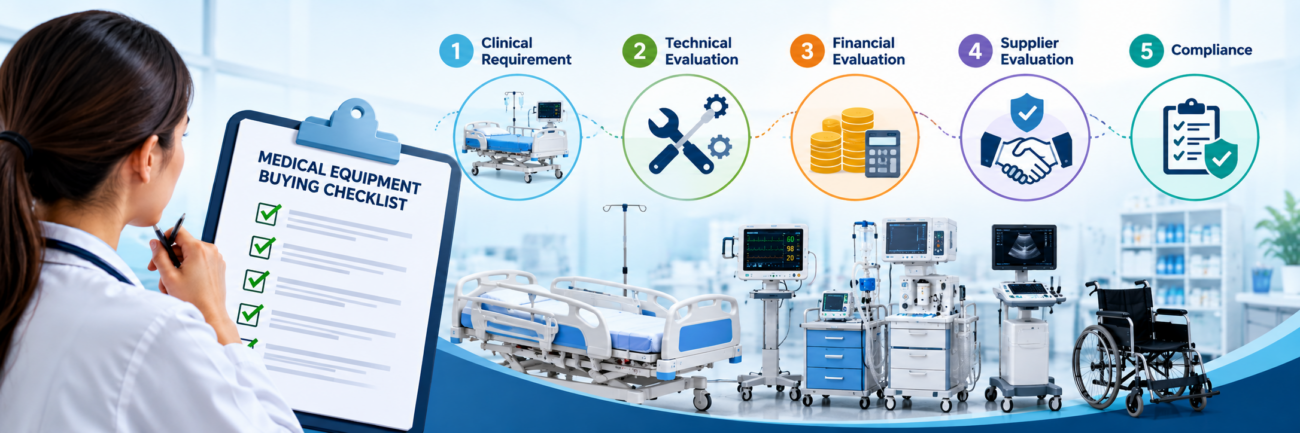
Use this easy to follow checklist before placing an order
Clinical Requirement
- Purpose identified
- Department identified
- Expected workload estimated
- Users identified
Technical Evaluation
- Specifications compared
- Required accessories checked
- Compatibility checked
- Power/site requirements checked
Financial Evaluation
- Purchase price compared
- Installation cost checked
- Consumables cost checked
- Maintenance cost considered
- The total cost of ownership was taken into account.
Supplier Evaluation
- Supplier credentials checked
- Warranty confirmed
- Service support confirmed
- Spare-parts availability checked
- Training availability confirmed
Compliance
- Applicable project requirements checked
- Product documentation received
- Licence/Documentation checked where applicable
- Installation documentation and acceptance planned.
10 Questions to ask a Medical Equipment Supplier
Before buying ask your supplier:
- What is the exact model and configuration?
- What are the most important specifications?
- What accessories are included?
- What additional accessories are required?
- What is the warranty period?
- Is installation included?
- Is staff training included?
- What is the expected maintenance requirement?
- Are spare parts and consumables readily available ?
- What after sales service will you provide ?
These questions can give hospitals and clinics a way of comparing suppliers more than just by price.
Common Mistakes to Avoid When Buying Medical Equipment
1. Choosing the cheapest equipment
Low upfront cost does not necessarily mean low long-term cost.
2. Buying too many features
Select features according to genuine clinical needs.
3. Ignoring maintenance
Maintenance is a service that should be provided prior to equipment’s failure, not following.
4. Not checking consumables
There are costs of consumables that occur regularly, which can have a significant impact on operational costs.
5. Ignoring staff training
Staff should be aware of safe and appropriate use of the equipment.
6. Comparing only product prices
Make a complete comparison, comprehensive installation, warranty, training and service.
7. Not checking supplier support
Post sale service from the supplier may be as significant as the initial purchase.
How to Choose the Right Medical Equipment Supplier in India ?

While selecting a medical equipment supplier in India, take into account five basic facts:
Product suitability + quality + regulatory compliance + service support + total cost
A trustworthy supplier ought to be able to give you a straightforward answer about:
- Product specifications
- Intended use
- Available models
- Warranty
- Installation
- Training
- Maintenance
- Consumables
- Spare parts
- After-sales support
Hospitals and clinics may find it more convenient to have a supplier who can assist them with the equipment even after its purchase.
Why Proper Medical Equipment Selection Matters
Healthcare facilities have long-term infrastructure requirements, such as medical equipment.
With a well planned purchase a facility can:
- Ensure that equipment is suitable for clinical needs
- Improve operational planning
- Reduce unexpected expenses
- Plan maintenance
- Support staff training
- Handle equipment in a lifecycle manner
Effective health technology procurement, according to WHO, can be defined as more than just the purchase of a product, instead it’s an exercise of evaluation, planning, needs assessment, procurement, installation, commissioning and monitoring.
Final Takeaway
When it comes to medical equipment for the hospital or clinic, it’s more than price comparisons.
Prior to the purchase assess the clinical needs, technical details, safety, regulatory aspects, installation, staff training, consumables, warranty, maintenance and after-sales.
Even with the best intentions, the most costly or feature-laden equipment is not necessarily the best. It is the equipment that the healthcare facility actually needs, based on the infrastructure, staff capabilities and long-term operational requirements of the facility.
A structured buying process can assist hospitals and clinics to make informed buying decisions and to implement effective equipment procurement and management during the life of the equipment.
FAQs
1. What should I consider when buying medical equipment for a hospital?
Take into account, as well as clinical requirements, technical specifications, safety, regulatory requirements, installation, staff training, warranty, maintenance, consumables and after-sales service.
2. How do hospitals choose medical equipment ?
The steps that hospitals typically take include determining their clinical and operational needs, assessing the types of equipment required, researching suppliers, costs, infrastructure needs, and long-term maintenance needs.
3. What medical equipment is commonly used in hospitals ?
These include patient monitors, ECG machines, ventilators, syringe pumps and infusion pumps, defibrillators, suction machines, hospital beds, and other critical and diagnostic equipment. Specific needs will vary based on the hospital department and service.
4. How do I choose a medical equipment supplier?
Consider product suitability, documentation, regulatory requirements applicable, warranty, installation, training, maintenance, spare parts and after sales service not just price, when comparing suppliers.
5. Is the cheapest medical equipment the best option?
Not necessarily. Installation, accessories, consumables, maintenance, as well as repair and replacement parts may be included. Thus, consider the overall life cycle cost.
6. Should a clinic buy or rent medical equipment?
It is dependent on the length and frequency of use of the equipment. Rental can be helpful if equipment is required for short periods, but buying may be the appropriate choice if the equipment is required in the long term.
7. Why is medical equipment maintenance important?
Inspection, preventative and corrective maintenance can keep equipment running effectively and safely and can facilitate longer term equipment management.
8. What documents should I check before purchasing medical equipment in India ?
Refer to the relevant regulatory/licensing information, manufacturer and product details, warranty, user documentation, and applicable testing, calibration, installation or service records, as applicable, for the device.